London’s transport network operates around the clock, connecting millions of people with work, education and everyday life. Maintaining and improving this infrastructure requires careful planning, accurate information and a clear understanding of what lies beneath the surface.
For projects involving roads, footways and transport infrastructure, underground utilities can present significant challenges. Electricity cables, water pipes, telecommunications ducts and other buried services may be hidden beneath the ground, making it difficult to establish their precise locations from surface observations alone.
This is where Ground Penetrating Radar (GPR) surveys can help.
At Intersect Surveys, we undertake surveying work in demanding environments, including sites associated with Transport for London (TfL).
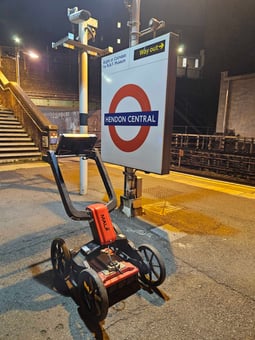
Why Are GPR Surveys Important on TfL Sites
Transport infrastructure presents a unique set of challenges. Roads and footways can contain extensive networks of underground services, often installed at different times and potentially altered throughout the years.
Existing utility records can provide a useful starting point, but they may not always show the full picture or accurately reflect the current position of every service.
Before planned works take place, survey information can help project teams understand the potential presence and location of buried infrastructure. This is particularly important when future activities could involve excavation, drilling, resurfacing or other work that may disturb the ground.
By helping identify potential underground obstructions and services, GPR surveys can support better-informed planning and help reduce uncertainty before intrusive works begin.
The information collected can also help engineers and contractors decide where further investigation may be needed. Where greater certainty is required, additional methods, such as physical verification, may be necessary.
Ultimately, the aim is to provide useful information that supports safer, more informed decisions about work around existing infrastructure.
Protecting the Public While Surveying
Surveying in a public environment requires a different level of consideration from working within a closed construction site.
On roads and footways, pedestrians, cyclists, motorists and public transport users may all be moving close to the survey area. Work must therefore be planned with the surrounding environment in mind, rather than focusing solely on the survey itself.
Before work begins, the site conditions, access requirements and potential hazards need to be considered as part of the appropriate planning and risk assessment process. The arrangements required will depend on the location, the work being undertaken and the level of interaction with the public and traffic.
Where necessary, suitable traffic management, barriers, signage or pedestrian arrangements can help separate the work area from people passing through it. The specific measures must be appropriate to the site and any applicable TfL requirements.
Keeping the survey team and members of the public safe also means considering how equipment is moved and operated, maintaining awareness of the surrounding environment and avoiding unnecessary obstruction to pedestrian routes.
These considerations are particularly important in busy urban locations, where even a relatively small working area can affect how people move around the site.
TfL's temporary traffic management guidance highlights the importance of keeping road users safe and ensuring that works do not create unnecessary barriers for pedestrians and other travellers.
Reducing Risk Before Work Begins
One of the main benefits of underground utility surveying is that it helps project teams investigate potential risks before ground is broken.
Striking an underground service during excavation can have serious consequences, including injury, disruption to essential services, delays and costly repairs. On a busy transport network, the wider effects can extend beyond the immediate work area.
The Health and Safety Executive's guidance on avoiding danger from underground services emphasises three key elements: planning the work, locating and identifying buried services, and carrying out excavation safely.
GPR can contribute to the investigation stage by providing additional information about potential underground features. When combined with appropriate records, complementary detection methods and further verification where required, this information can help reduce uncertainty and inform decisions about subsequent works.
It is important to remember that a survey does not remove every risk. The results need to be understood within the limits of the detection methods used, and excavation must still follow the appropriate safe systems of work.
Accurate Information for Complex Environments
Surveying on transport infrastructure requires technical knowledge, attention to detail and an understanding of the environment in which the work takes place.
Every location presents its own considerations, from the density of underground infrastructure to surface conditions, access restrictions and the need to maintain safe movement around the site.
At Intersect Surveys, our approach is tailored to the requirements of each project. Selecting suitable surveying techniques and presenting the resulting information clearly helps provide clients and project teams with a better understanding of existing site conditions.
For GPR surveys, that means interpreting the data carefully, identifying potential subsurface features and communicating the findings in a way that supports the next stage of the project.
Supporting Transport Infrastructure Through Surveying
Behind every successful infrastructure project is a need for reliable information.
GPR surveys help investigate what may be hidden beneath roads and footways, supporting project teams as they plan work around existing underground infrastructure. In busy public environments, that information is one part of a wider process involving careful planning, risk management and consideration for the people who use the network every day.
Through our work on TfL-associated sites, Intersect Surveys contributes to the surveying information needed to understand these complex environments.
Whether a project requires GPR, utility mapping or a combination of surveying services, our focus is on providing accurate, useful information tailored to the site and its requirements.
Planning works involving underground utilities or transport infrastructure? Contact Intersect Surveys to discuss your project and find out how our surveying services can support your plans.